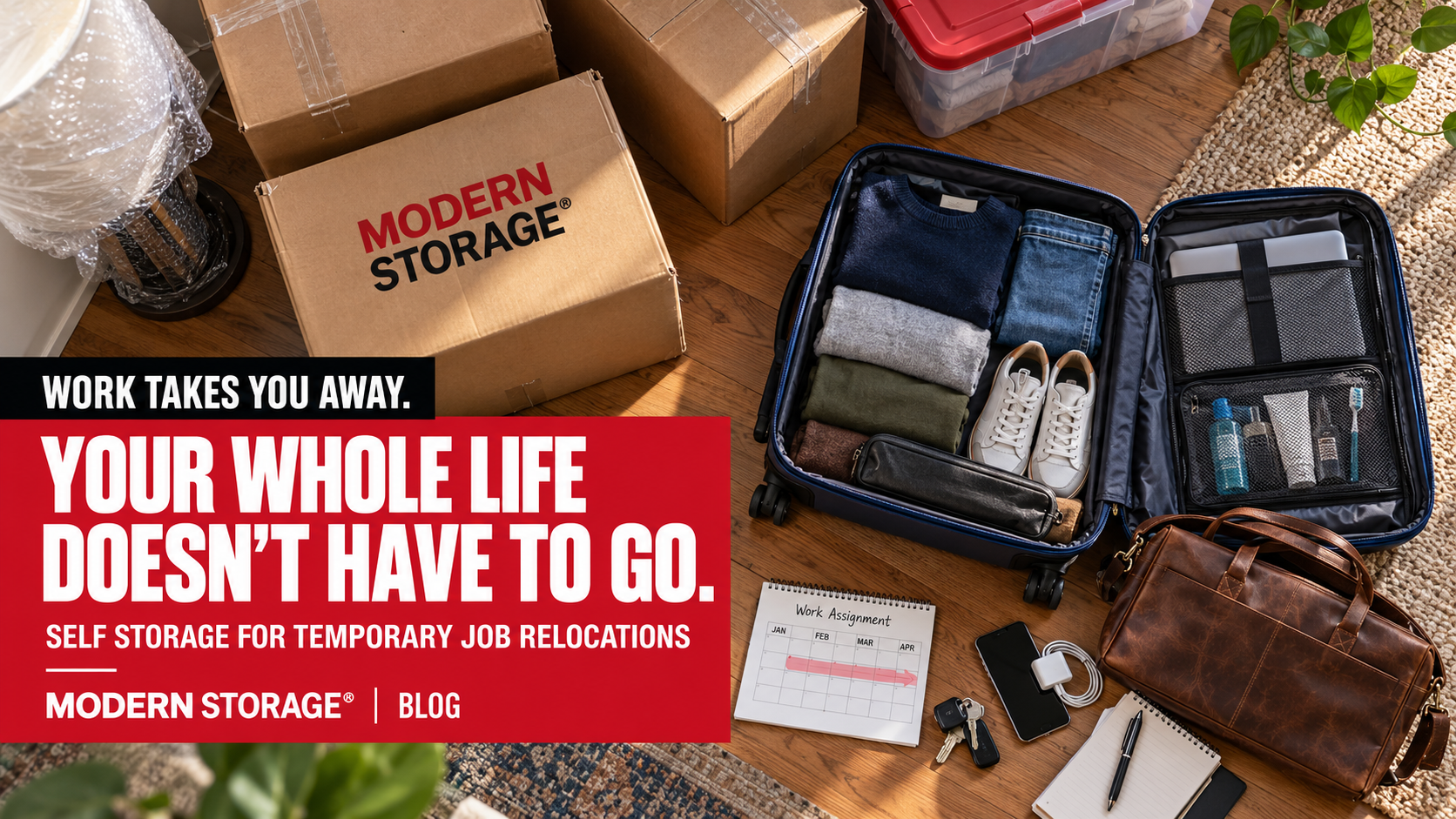
You get an opportunity to work in another city for six months. Maybe it's a temporary assignment, contract position, training program, internship, or project that could be great for your career. There's just one problem: What are you supposed to do with everything at home? Moving an entire household for a temporary assignment may not make sense—especially if you're heading to a furnished apartment, corporate housing, or another short-term living arrangement. On the other hand, continuing to pay for a larger home or apartment just to hold your belongings may not make sense either. Self storage can provide a middle ground. Take what you'll actually need for the assignment, store the rest, and make the temporary move without treating it like a permanent relocation.
Temporary Job, Very Real Moving Problem
Temporary work opportunities come in many forms. You may be sent to another city for a project, accept a contract position, complete a training program, take an internship, or temporarily relocate while helping open or manage another location.
The assignment may only last a few months, but you still have to figure out what happens to your home and everything inside it while you're gone.
Don't Move Your Entire Life for a Temporary Assignment
A permanent relocation and a temporary work assignment are two very different moves. If you're heading to furnished housing or a smaller temporary residence, moving every piece of furniture and every box you own may create more work than necessary.
Instead, think of the relocation more like an extended stay. Bring what will make the temporary home functional and comfortable, and create another plan for everything you won't need until you return.
Start With Three Categories
Before you start putting everything into boxes, divide your belongings into three basic groups: going with you, going into storage, and things you no longer need.
- Take with you: belongings you'll regularly use during the assignment
- Store: belongings you want to keep but won't need while you're away
- Let go: items you no longer use and don't want to move or store
Making these decisions before moving day can prevent you from paying to transport or store belongings you already planned to get rid of.
What Should Go With You?
Your temporary setup should include the things you'll realistically need for everyday life and work—not everything you might possibly want at some point.
- Work clothing
- Everyday clothing
- Medications
- Important documents
- Laptop and work equipment
- Chargers and electronics
- Toiletries and personal necessities
- A limited amount of seasonal clothing
- Frequently used personal items
- A few things that make temporary housing feel like home
If you're driving to the temporary location, remember that everything you take eventually has to come back—or move somewhere else if your plans change.
What Can Go Into Storage?
Storage can handle the belongings you want to keep but don't need to follow you to a temporary assignment.
- Furniture
- Extra household items
- Seasonal clothing
- Holiday decorations
- Books
- Home décor
- Kitchen items you won't need
- Extra bedding and linens
- Sports and recreational equipment
- Keepsakes and collections
- Packed household boxes
Keeping these belongings together can be much easier than scattering them between friends' houses, family members' garages, and several different closets while you're gone.
Make Returning Home Easier
Pack as though you're eventually going to unpack everything again—because you are.
Clearly label boxes, keep similar items together, and create a basic inventory. If you unexpectedly need something while you're away, you'll have a much better chance of knowing exactly where it is.
- Label every box with its contents
- Group boxes by room or category
- Disassemble furniture carefully
- Keep furniture hardware labeled
- Photograph complicated furniture before disassembly
- Create a basic digital inventory
- Keep anything you may need toward the front
- Avoid blocking frequently accessed belongings with large furniture
Consider Climate Control for Certain Belongings
If you'll be away for several months, you may want to consider climate-controlled storage for certain belongings.
Climate-controlled storage provides a more consistent environment than a standard unit and may be worth considering for certain furniture, electronics, documents, photographs, artwork, and other materials that can be sensitive to significant temperature or humidity changes.
Climate control doesn't guarantee against damage, so belongings should still be clean, completely dry, and properly packed before going into storage.
What If the Assignment Gets Extended?
A three-month assignment can become six months. A six-month project can stretch closer to a year. Temporary work timelines can change.
That's where month-to-month storage can be especially useful. Instead of trying to predict exactly how long the assignment will last before you leave, you have more flexibility if your plans change.
What If Temporary Becomes Permanent?
Sometimes the temporary city starts feeling less temporary. You may receive a permanent offer, decide you like the new location, or realize the assignment has opened the door to another opportunity.
Having your belongings in storage gives you time to make that decision without rushing. Once your long-term plans are clear, you can decide what should move with you, what you still want to keep, and what you may no longer need.
You Don't Have to Make a Temporary Move Feel Permanent
Moving is a lot of work. Moving an entire household to another city and then moving it all back a few months later is even more work.
If your job relocation has an end date—or even an approximate one—keeping the move smaller can save you from unpacking an entire household somewhere you were never planning to stay long-term.
Final Thoughts
A temporary job relocation can be a great career opportunity without requiring a permanent decision about everything you own.
Take the things you need. Store the things you want to come back to. And give yourself room to figure out what happens next.
With month-to-month rental options, Modern Storage® can provide a flexible place for furniture, household belongings, seasonal items, and other possessions while work temporarily takes you somewhere else.
Should I use storage if I'm temporarily relocating for work?
It can be useful when you don't need or want to take your entire household with you. Storage gives belongings a temporary place to stay while you move only what you'll need during the assignment.
What should I take with me for a temporary work assignment?
Bring everyday clothing, work supplies, medications, important documents, electronics, personal necessities, and anything you'll regularly use. Furniture, seasonal belongings, décor, extra household items, and other things you won't need may make more sense in storage.
Can I rent a storage unit for only a few months?
Modern Storage® offers month-to-month rentals, making storage useful for temporary situations where you may not know exactly how long you'll need the space.
Should I consider climate-controlled storage while I'm away?
Climate-controlled storage may be worth considering for certain belongings that can be sensitive to significant temperature and humidity changes. It provides a more consistent environment than a standard unit but does not guarantee against damage.
What if my temporary job turns into a permanent relocation?
Keeping belongings in storage can give you time to make that decision without immediately moving everything. If the assignment becomes permanent, you can decide what you want to move, keep, donate, or otherwise handle once your long-term plans are clearer.
Storage options, unit types, amenities, and availability vary by Modern Storage® facility. Rental terms and move-out requirements may vary. Contact your facility for current availability and help choosing a storage option for your relocation.