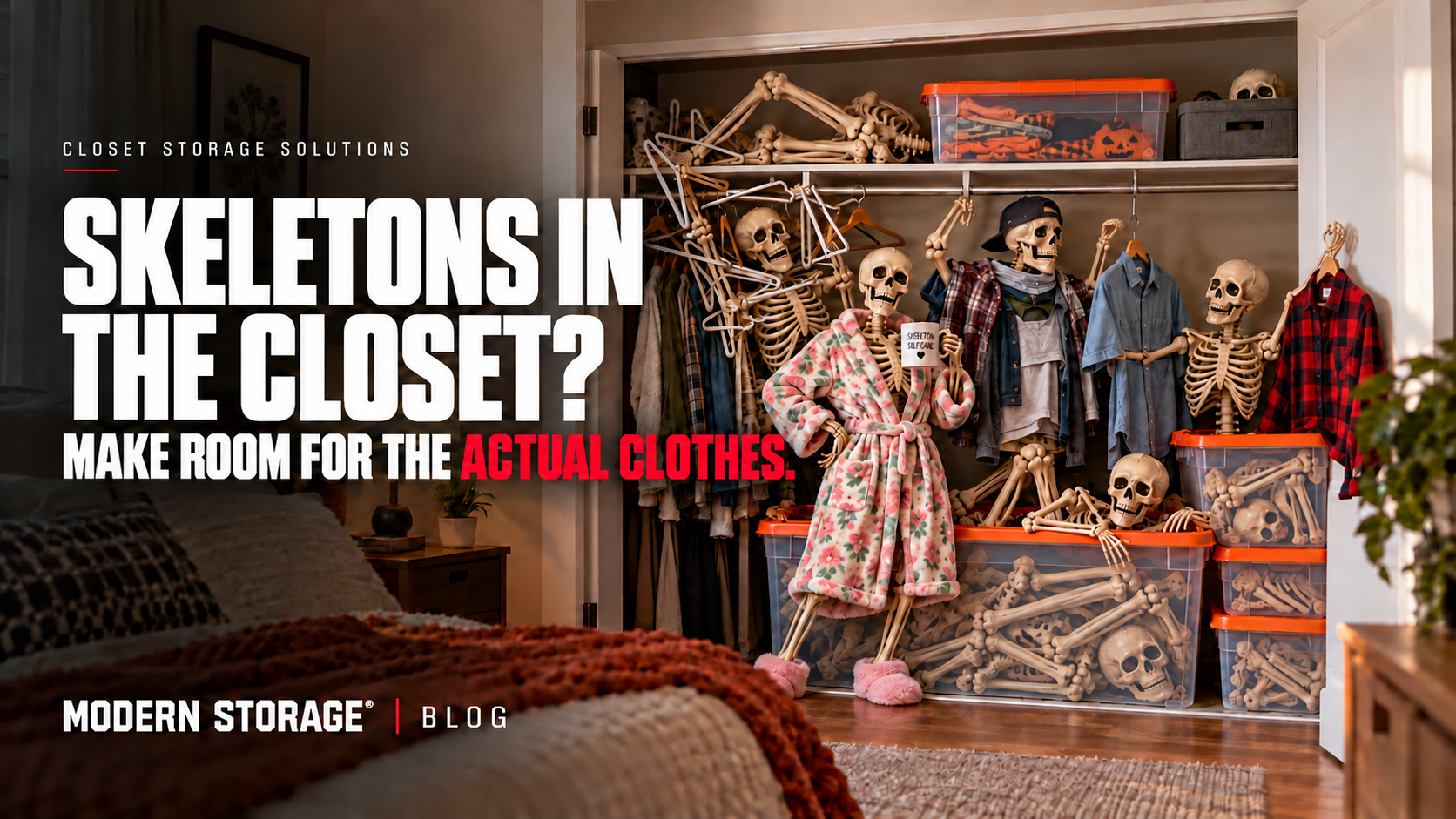
Everyone has a few skeletons in their closet. Some of us have actual plastic ones. Along with three pumpkins, a Halloween wreath, last year's costumes, a box of Christmas ornaments, an inflatable you bought on clearance, and a collection of mystery containers that haven't been opened since 2022. Meanwhile, your actual clothes are fighting for survival on one overcrowded hanging rod. Sound familiar? Closets have a funny way of becoming the unofficial storage unit of the house. When your closet is holding more seasonal decorations than clothes, it might be time for a little rearranging.
There Really Are Skeletons in Your Closet
For some people, skeletons in the closet are just an expression. For others, there's a plastic skull staring back at them every time they reach for a jacket.
Halloween decorations are a perfect example of how seasonal belongings end up taking over everyday storage spaces. They're used for a few weeks, packed away, and shoved into whichever closet still has room.
Then Christmas arrives. Then spring decorations. Then summer gear. Before you know it, your closet is hosting every holiday on the calendar.
How Did All This Stuff Get in Here?
Closet clutter rarely happens all at once. It usually starts with one innocent decision.
You put the suitcase on the top shelf because you don't have another place for it. Then a box of holiday decorations goes beside it. Then the extra blankets get stacked underneath. Eventually, anything that doesn't have an obvious home gets added to the collection.
The problem isn't always that you own too much. Sometimes it's that too many unrelated categories are competing for the same limited space.
Step One: Find the Actual Clothes
Before buying more hangers, shelves, or closet organizers, take a look at what's actually occupying the space.
Pull out the things that don't belong in your everyday wardrobe area and group them by category.
- Clothing and shoes you wear regularly
- Out-of-season clothing
- Holiday decorations
- Luggage and travel accessories
- Extra bedding and blankets
- Keepsakes and sentimental items
- Miscellaneous household supplies
- Items you no longer need or use
Once everything is separated, you'll have a much clearer picture of how much of your closet is actually being used for clothing.
The Everyday vs. Occasionally Used Test
One of the easiest ways to decide what belongs in a closet is to ask how often you use it.
Your everyday shoes, work clothes, jackets, and frequently worn outfits deserve convenient access. The suitcase you use twice a year and the box of Halloween decorations you won't touch until next October probably don't need the same priority.
Stop Letting Holiday Decorations Take Over
Halloween decorations are fun. Sharing your bedroom closet with them for the other eleven months of the year? Less fun.
Pumpkins, wreaths, costumes, tabletop decorations, signs, and other seasonal pieces can consume valuable shelf and floor space.
Instead of spreading seasonal décor throughout every available closet, consider keeping holiday collections together in a dedicated storage area.
That way, Halloween stays with Halloween, Christmas stays with Christmas, and your sweaters no longer have to compete with a box of plastic spiders.
Give Bulky Household Items Somewhere Else to Go
Sometimes the biggest closet offenders aren't decorations at all.
Extra comforters, luggage, seasonal sports equipment, spare household items, and sentimental belongings can take up an enormous amount of space.
If you want to keep these things but don't use them regularly, dedicated self storage may be a practical option.
- Seasonal decorations
- Extra luggage
- Properly packed seasonal clothing
- Spare household items
- Keepsakes and memory boxes
- Extra bedding
- Seasonal recreational equipment
- Occasionally used household accessories
Make the Space You Have Work Better
Once you've removed the things that don't belong, you may discover your closet has more usable space than you realized.
Organize clothing by category, use appropriate hangers, keep frequently worn items within easy reach, and consider shelves or organizers that fit your available space.
The goal isn't to create a picture-perfect closet that never gets messy. It's to create a space that makes everyday routines easier.
What Should Stay at Home?
Not everything belongs in storage just because it isn't used every day.
Important documents, essential medications, emergency supplies, valuables you need immediate access to, and anything you rely on regularly should remain somewhere appropriate and accessible at home.
Self storage works best for belongings you want to keep but don't need within arm's reach.
Keep the Clutter From Creeping Back
The real challenge isn't cleaning out the closet once. It's keeping it from becoming the household's unofficial lost-and-found department again.
Give each category a designated home. When something new comes in, decide where it belongs instead of automatically placing it on the nearest available shelf.
A quick seasonal review can also help you identify belongings that no longer need to occupy prime closet space.
Your Closet Shouldn't Be a Haunted House
Opening your closet shouldn't involve balancing falling containers, moving holiday decorations, or wondering what might be hiding behind the luggage.
Sometimes reclaiming your space doesn't require a bigger house, a walk-in closet, or a complete wardrobe overhaul. It simply requires finding a better home for the things that don't belong there.
Final Thoughts
If your closet has become a hiding place for holiday decorations, extra bedding, luggage, keepsakes, and everything else without a designated home, it's time to give your actual clothes some breathing room.
Keep the belongings you use regularly accessible, relocate the things you only need occasionally, and create a system that works for your everyday life.
Modern Storage® can help give your seasonal belongings and household overflow a dedicated place—so the next time you open your closet, the only thing staring back at you is an outfit you actually want to wear.
How do I make more room in a small closet?
Start by removing anything that doesn't need to be there. Sort clothing, shoes, seasonal decorations, luggage, extra bedding, and miscellaneous household items into categories. Keep everyday essentials accessible and relocate items used only occasionally.
What should I remove from an overcrowded closet first?
Start with bulky, rarely used items such as holiday decorations, extra luggage, seasonal sports equipment, unused household items, and out-of-season clothing.
Is self storage useful for closet overflow?
Yes. Self storage can be helpful for seasonal belongings, keepsakes, extra household items, and other things you want to keep but don't need to access every day.
Should I store seasonal clothing in a climate-controlled unit?
Climate-controlled storage may be worth considering for clothing, fabrics, keepsakes, and other materials sensitive to significant temperature and humidity changes. It provides a more consistent environment but does not guarantee against damage.
How do I keep my closet from getting cluttered again?
Give every category a designated place, periodically review what you're keeping, and avoid using the closet as the default destination for items that don't belong anywhere else.
Storage options, unit types, amenities, and availability vary by Modern Storage® facility. Belongings should be clean, completely dry, and appropriately packed before storage. Follow manufacturer recommendations for specialty items.